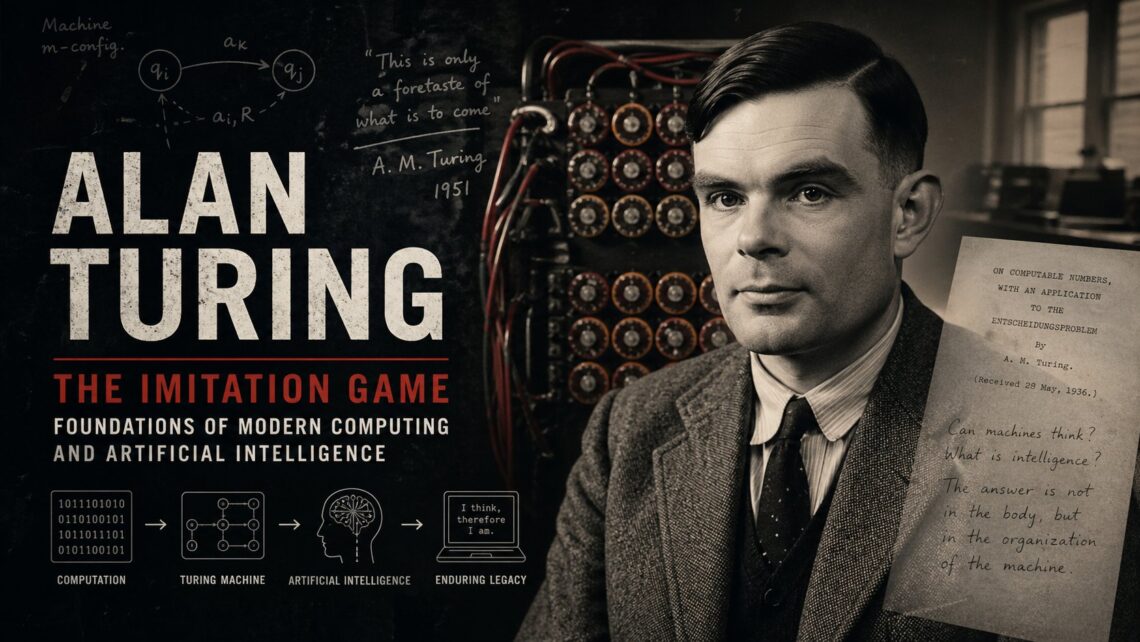
Alan Turing and the imitation game occupy a central place in the intellectual history of modern science. Alan Mathison Turing (1912–1954) was a British mathematician, logician, and cryptanalyst whose ideas laid the theoretical and practical foundations of computer science and artificial intelligence. Alongside early computing pioneers such as Ada Lovelace – often recognized as the first computer programmer – Turing shaped humanity’s understanding of what machines can compute and, more provocatively, whether they can be said to think.
Public awareness of Turing’s life increased substantially after the release of the 2014 film The Imitation Game. However, his intellectual legacy rests primarily on a body of academic work that remains essential to contemporary computing, artificial intelligence research, and the philosophy of mind.
Theoretical Foundations of Computation
Alan Turing’s most influential contribution to theoretical computer science is his 1936 paper “On Computable Numbers, with an Application to the Entscheidungsproblem.” In this work, Turing introduced the abstract concept now known as the Turing Machine, a formal model capable of describing any computation that can be carried out by an algorithm.
This paper provided a rigorous definition of computation itself and demonstrated the existence of a universal machine, a single device capable of simulating any other computational process. The significance of this idea cannot be overstated: it established the conceptual basis for programmable digital computers and delineated the limits of mechanical calculation. Modern fields such as algorithm design, computational complexity, and programming language theory continue to rely on the framework Turing developed.
For an accessible philosophical overview of these ideas, see the Stanford Encyclopedia of Philosophy entry on Turing machines: https://plato.stanford.edu/entries/turing-machine/
Cryptanalysis and World War II: Bletchley Park
During World War II, Turing worked at Bletchley Park, the British Government Code and Cypher School. His cryptanalytic work focused primarily on breaking German military communications encrypted by the Enigma machine. Turing played a key role in the development of the Bombe, an electromechanical device that dramatically accelerated the process of identifying Enigma’s daily settings.
The successful decryption of Enigma messages provided Allied commanders with crucial strategic intelligence and is widely regarded as having shortened the war and saved millions of lives. These achievements, however, remained classified for decades, preventing contemporary recognition of Turing’s contributions.
For historical and technical context, see the National Museum of Computing’s overview of the Bombe:
https://www.tnmoc.org/bombe
The Imitation Game and the Origins of Artificial Intelligence
In 1950, Turing published “Computing Machinery and Intelligence” in the journal Mind. Rather than attempting to define intelligence in abstract philosophical terms, Turing reframed the question “Can machines think?” through an operational experiment, the imitation game, now widely known as the Turing Test.
In this test, a machine is considered intelligent if its responses in a text-based conversation are indistinguishable from those of a human interlocutor. This proposal marked a turning point in artificial intelligence research by shifting attention toward observable behavior and practical evaluation.
Although the imitation game has been widely debated and critiqued, it remains a foundational concept in discussions of artificial intelligence, human–computer interaction, and machine ethics. A concise reference overview is available via Encyclopaedia Britannica: https://www.britannica.com/technology/Turing-test
The Imitation Game (2014): Cultural Representation and Limits
The 2014 film The Imitation Game brought Alan Turing’s story to a global audience, emphasizing both his wartime contributions and the injustice he endured due to the criminalization of homosexuality in mid‑twentieth‑century Britain. While the film played an important role in restoring Turing’s place in public memory, it took significant dramatic liberties.
From a scholarly perspective, the film exaggerates aspects of Turing’s personality and professional relationships and simplifies the collaborative nature of cryptanalytic work at Bletchley Park. As such, it should be viewed as an interpretive cultural narrative rather than a strict historical account. Nevertheless, its impact on public understanding and renewed academic interest in Turing has been substantial.
Persecution, Recognition, and Ethical Reflection
In 1952, Alan Turing was prosecuted for homosexual acts and subjected to chemical castration. He died in 1954 at the age of 41. His treatment is now widely recognized as a grave ethical failure by the state, particularly given his extraordinary service during wartime.
Posthumous recognition has partially addressed this injustice. In 2009, the British government issued a formal apology; in 2013, Turing received a royal pardon; and in 2021, his image appeared on the UK £50 banknote. These acts of recognition underscore the enduring importance of confronting historical injustice within scientific and political institutions.
Conclusion: Why Alan Turing and the Imitation Game Still Matter
Alan Turing and the imitation game remain central to understanding the foundations of modern computing and artificial intelligence. His theoretical work defines the limits and possibilities of computation, while his philosophical insights continue to shape contemporary debates about machine intelligence, ethics, and human responsibility.
When considered alongside figures such as Ada Lovelace, Turing’s legacy highlights both the intellectual depth and the social context behind technological innovation. His life serves not only as a cornerstone of computer science, but also as a reminder that scientific progress must be accompanied by ethical progress.
Academic References
Primary Sources
- Turing, A. M. (1937). On computable numbers, with an application to the Entscheidungsproblem. Proceedings of the London Mathematical Society, s2‑42(1), 230–265. https://doi.org/10.1112/plms/s2-42.1.230
- Turing, A. M. (1950). Computing machinery and intelligence. Mind, 59(236), 433–460. https://doi.org/10.1093/mind/LIX.236.433
Secondary Sources
- Hodges, A. (2014). Alan Turing: The enigma (Updated ed.). Princeton University Press.
- Copeland, B. J. (2012). Turing: Pioneer of the information age. Oxford University Press.
- Russell, S., & Norvig, P. (2021). Artificial intelligence: A modern approach (4th ed.). Pearson.