Real-world cases from Equifax to Razer illustrate the human and financial toll of cyberattacks. A security breach rarely announces itself. It begins with a misconfiguration, an unpatched vulnerability, or a single employee clicking the wrong link — and ripples outward in ways that can take years to resolve. The consequences…
-
-
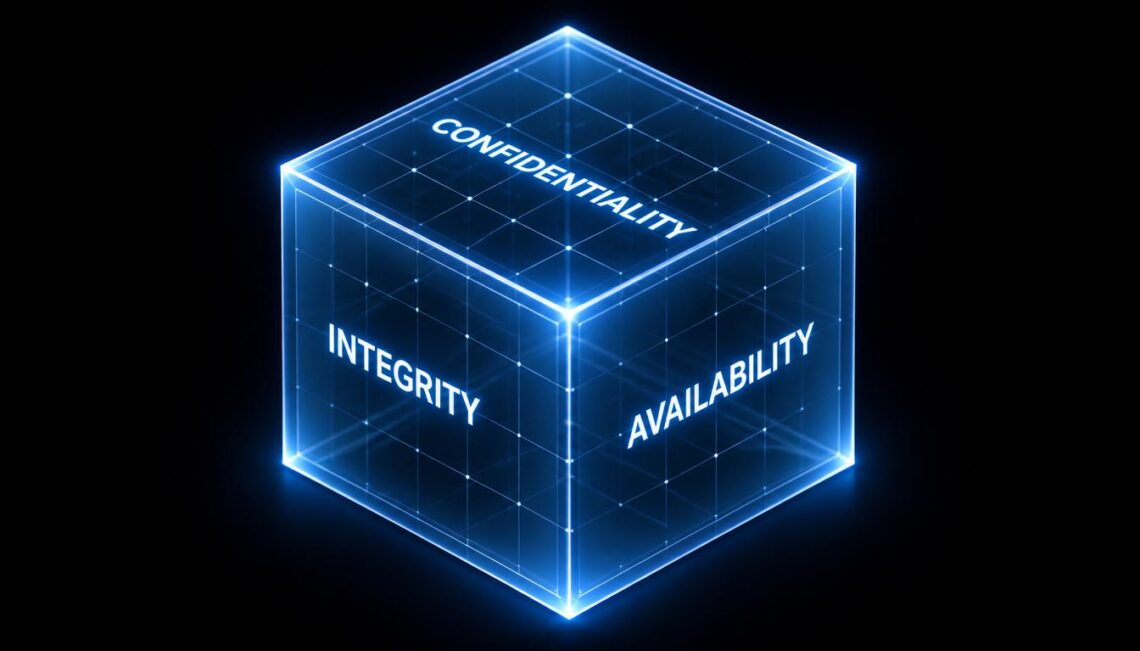
The McCumber Cube: A Blueprint for Information Security
How a 1991 model still guides organizations in protecting everything from databases to IoT sensors. In 1991, John McCumber proposed a three-dimensional model that remains one of the clearest frameworks for evaluating an organization’s security posture. Known as the McCumber Cube, it asks security teams to consider three overlapping dimensions…
-
What They Know About You: The Anatomy of Personal Data
From medical records to smart devices, your data footprint is far larger than you think. Personal data is any information that can be used to identify you — your name, social security number, date and place of birth, your mother’s maiden name, even the messages you exchange with family. Cybercriminals…
-
You Have Two Selves and Both Need Protection
Understanding your offline and online identity in an age of constant surveillance. A cyberattack happens every 39 seconds — and the relationship between online identity and cybersecurity has never been more consequential. The target of these attacks isn’t always a bank or a government. More often, it’s an ordinary person who underestimated…
-
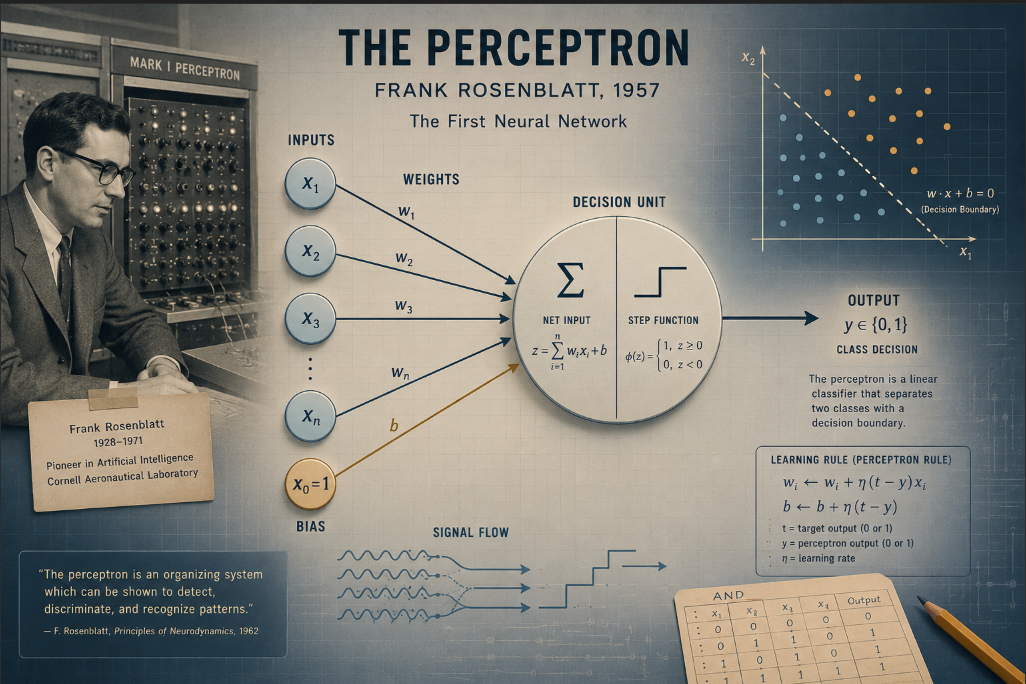
Frank Rosenblatt Perceptron: The First Neural Network
Introduction: Why the Perceptron Still Matters The Frank Rosenblatt perceptron is widely recognized as the first artificial neural network and a foundational model in the history of machine learning and artificial intelligence. Introduced in the late 1950s, the Frank Rosenblatt perceptron demonstrated how learning could emerge from adaptive systems using…
-
Alan Turing and The Imitation Game: Foundations of Modern Computing and Artificial Intelligence
Alan Turing and the imitation game occupy a central place in the intellectual history of modern science. Alan Mathison Turing (1912–1954) was a British mathematician, logician, and cryptanalyst whose ideas laid the theoretical and practical foundations of computer science and artificial intelligence. Alongside early computing pioneers such as Ada Lovelace…
-
Your First Python Program: A Beginner’s Guide
Welcome to the exciting world of Python programming! Whether you’re a complete beginner to coding or just new to Python, this guide will walk you through creating and running your very first Python program. Let’s get started on this journey into one of the most popular and versatile programming languages…
-
Ada Lovelace: Origins of Modern Computing
Abstract Augusta Ada King, Countess of Lovelace (1815–1852), is recognized as a foundational figure in Ada Lovelace early computing. Her collaboration with Charles Babbage on the Analytical Engine produced the first published algorithm and advanced a theoretical understanding of computation more than a century ahead of modern computer technology. This…
-
TodoApp CTF Walkthrough: Mobile Security Challenge Guide
This TodoApp CTF walkthrough provides a complete step-by-step guide to solving this medium-difficulty mobile security challenge. If you’re tackling the TodoApp CTF for the first time, this walkthrough will guide you through discovering and exploiting the hidden vulnerabilities in TechCorp’s productivity application. Challenge Details Name: TodoAppFile: todoapp.apkPlatform: https://ctf.alquymia.com.br/Category: MISCDifficulty: Medium…
-
Hollow Alternativo CTF Walkthrough: XSS & IDOR Exploitation
Challenge Details Name: Hollow AlternativoURL: https://pipposnow.alqlab.com/Platform: https://ctf.alquymia.com.br/Category: WebDifficulty: Medium Initial Clues Phase 1: Reconnaissance and Proactive Code Analysis Since there is no obvious error to guide us, we must actively hunt for the vulnerability by examining the page’s code. Step 1.1: Formulate a Hypothesis The achievements are not loading. This…