Introduction: Why the Perceptron Still Matters
The Frank Rosenblatt perceptron is widely recognized as the first artificial neural network and a foundational model in the history of machine learning and artificial intelligence. Introduced in the late 1950s, the Frank Rosenblatt perceptron demonstrated how learning could emerge from adaptive systems using weighted inputs and error‑driven updates rather than explicit symbolic programming.
Far from being a historical footnote, the perceptron provided the conceptual blueprint for modern neural networks. Understanding Rosenblatt’s work is essential for grasping how contemporary AI systems evolved from early biologically inspired learning models into today’s powerful data‑driven technologies.
Frank Rosenblatt: Background and Intellectual Motivation
Frank Rosenblatt (1928–1971) was trained as a psychologist, a fact that deeply shaped his approach to artificial intelligence. Rather than viewing intelligence as a product of explicit rules and symbolic reasoning, Rosenblatt believed intelligent behavior emerges from adaptive systems composed of many simple processing units.
During the 1950s, much AI research—particularly at elite institutions—focused on symbolic logic and hand‑crafted rules. Rosenblatt rejected this paradigm, drawing inspiration instead from neuroscience, experimental psychology, and statistical decision theory. His goal was to design systems that could learn from experience, rather than being explicitly programmed for every task.
This perspective positioned the perceptron as a radical alternative to dominant AI approaches of the era and laid the groundwork for what would later be called connectionism.
What Is the Perceptron? A Foundational Neural Network Model
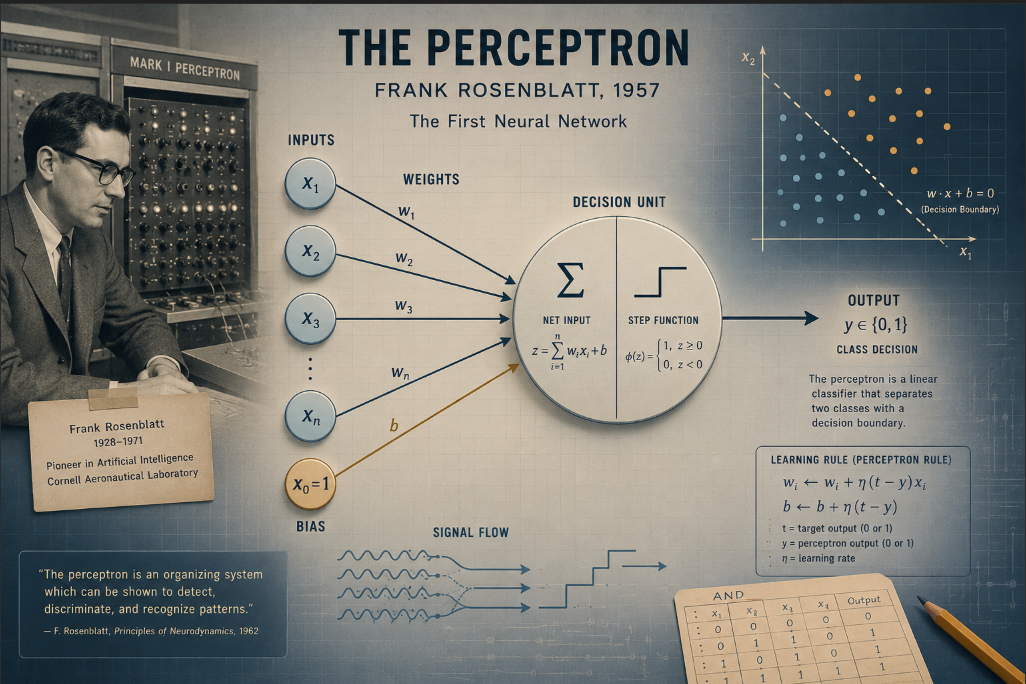
The perceptron is a simple computational model designed to classify inputs into one of two categories. It works by combining multiple input signals, each weighted according to its importance, and producing a binary output decision based on whether the combined signal exceeds a threshold.
In practical terms, the perceptron functions as a linear classifier, separating input data into two classes using a single decision boundary. While limited, this model provided an explicit and testable account of how learning could occur through gradual adjustment rather than symbolic reasoning.
Importantly, the perceptron introduced the idea that learning could be achieved by modifying parameters based on experience—a core principle that underpins modern machine learning.
How the Perceptron Learning Algorithm Works
Rosenblatt’s most influential contribution was not the perceptron’s structure, but its learning algorithm. The perceptron learns using labeled examples, a process now known as supervised learning.
For each training example, the system compares its prediction to the correct label. If the prediction is wrong, the perceptron adjusts its internal weights in a direction that would reduce the error in the future. If the prediction is correct, no adjustment is made.
This training method introduced several foundational ideas:
- Learning is driven by errors
- Weight updates depend only on local information
- The system improves incrementally through experience
Rosenblatt also proved that if a problem can be solved using a linear decision boundary, the perceptron learning algorithm is guaranteed to converge after a finite number of updates. This result remains a landmark in learning theory.
Biological Inspiration and Early Neural Architectures
Rosenblatt envisioned the perceptron not as an isolated unit, but as part of a larger biologically inspired system. He proposed architectures that included sensory units for input, association units for intermediate processing, and response units for output decisions.
Although early implementations simplified these ideas into a single computational layer, Rosenblatt explicitly anticipated multi‑layer neural networks. He argued that more complex behavior would require multiple stages of processing, even though efficient training methods for such systems did not yet exist.
This forward‑looking architectural vision closely resembles the structure of modern deep neural networks.
The Mark I Perceptron: One of the First Learning Machines
In 1958, Rosenblatt led the development of the Mark I Perceptron, one of the first machines capable of learning from data in hardware. The system used photocells to detect visual patterns, analog circuitry to represent adjustable weights, and mechanical components to update those weights during training.
The Mark I Perceptron successfully learned to distinguish simple visual categories, attracting widespread public attention. However, limitations in hardware precision, scalability, and reliability constrained its performance and fueled skepticism among critics.
Despite these constraints, the Mark I Perceptron stands as a historic milestone in the development of intelligent systems.
Limits of the Perceptron: The XOR Problem Explained
The main limitation of the perceptron arises from its reliance on a single linear decision boundary. As a result, it cannot solve problems that require nonlinear separation.
The most famous example is the XOR problem, where outputs cannot be separated using a straight dividing line. In the late 1960s, researchers demonstrated that many important computational tasks—including parity detection and certain symmetry problems—were impossible for single‑layer perceptrons.
While these findings were mathematically correct, they were often misinterpreted as a fundamental failure of neural network approaches rather than a limitation of a specific architecture.
Perceptrons and the First AI Winter
The critique of perceptrons coincided with limited computing power, exaggerated public expectations, and the absence of effective training algorithms for multi‑layer networks. Together, these factors contributed to the first AI winter, during which funding and enthusiasm for neural network research declined sharply.
Ironically, Rosenblatt himself argued that more powerful learning systems would require multiple layers and richer representations. However, practical algorithms comparable to modern backpropagation would not be formalized until many years later.
From Perceptron to Deep Learning: Lasting Influence on Neural Networks
Despite its simplicity, the perceptron remains central to modern AI:
- Every artificial neuron is a generalization of the perceptron
- Weighted inputs and activation functions remain fundamental
- Error‑driven learning continues to guide model training
Modern advances—such as nonlinear activations, deep architectures, and gradient‑based optimization—extend Rosenblatt’s original framework rather than replacing it.
From a conceptual standpoint, the perceptron can be viewed as the simplest possible neural network and a precursor to linear models such as logistic regression and support vector machines.
Conclusion: Rosenblatt’s Enduring Legacy in Artificial Intelligence
Frank Rosenblatt’s perceptron was not a dead end in AI research, but a foundational breakthrough that clarified how learning could emerge from adaptive systems rather than explicit rules.
Although its limitations temporarily slowed progress, the perceptron’s principles directly shaped the resurgence of neural networks and the success of modern machine learning. Rosenblatt’s core insight—that intelligence can arise from distributed, learning systems composed of simple units—remains a guiding idea at the heart of artificial intelligence today.