Grace Hopper: Origins of Compiler Technology
Grace Hopper (1906–1992) established the foundations of modern computer programming through her invention of the first compiler, a program that automatically translates human-readable instructions into machine code, and her work as a pioneer of machine-independent programming languages (ones that run on any computer, not just a specific model). Her creation of the A-0 compiler in 1952 revolutionized how humans interact with computers by translating English-like commands into machine code, making programming accessible beyond the small community of specialists who understood binary machine instructions. This article examines Hopper’s technical innovations in compiler technology, her role in developing COBOL as the first widely-used business programming language, and her lasting impact on software engineering as a discipline.
1. Introduction
Grace Hopper didn’t just write code, she invented how we write code. Before her work, programming meant directly entering binary machine instructions (the strings of 0s and 1s that computers actually understand) or laboriously hand-wiring connections for each computation. Her revolutionary insight was that computers could be programmed using human-readable language, with software automatically translating these instructions into machine code. This concept, implemented as the first compiler, transformed computing from an inaccessible art into a practical tool used by millions.
Her career spanned the entire evolution of electronic computing, from the Harvard Mark I in 1944 to the rise of personal computers. Throughout these transformations, Hopper’s vision remained consistent: computing should be accessible to those who needed to use it, not restricted to those who understood machine architecture. Her work established the foundation for modern software engineering.
- Computer History Museum’s Grace Murray Hopper profile: https://www.computerhistory.org/atchm/grace-murray-hopper/
- UNIVAC history and early computing: https://www.computerhistory.org/revolution/early-computer-companies/5/100
2. Scientific and Social Context of Early Computing
Hopper’s innovations emerged during the transformative period when electronic computers were proving their practical value but programming remained extremely difficult. The Harvard Mark I, UNIVAC, and early IBM computers demonstrated computing’s potential for scientific calculations, business data processing, and military applications but each program required painstaking preparation by specialists who understood both the problem and the machine’s specific architecture.
Simultaneously, women played crucial roles in early computing as “human computers” and programmers, though their contributions were often overlooked in histories that focused on hardware inventors. Hopper’s career exemplified how women provided essential programming and software innovations during computing’s foundational decades.
3. Education and Path to Computing
3.1 Mathematical Foundation
Born in 1906 in New York City, Grace Murray showed early aptitude for mathematics. She pursued mathematics at Vassar College and continued to Yale for her master’s and PhD, unusual educational achievements for women of her generation. Her doctoral work in mathematics established her analytical abilities, but World War II would redirect her talents toward computing.
3.2 Naval Service and the Harvard Mark I
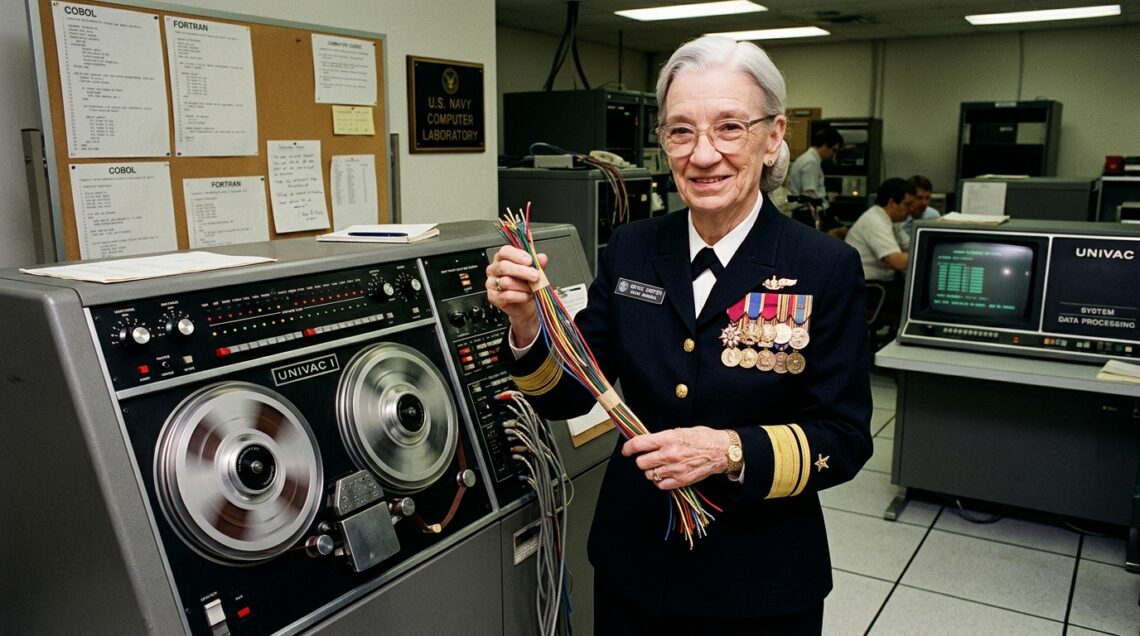
At age 34, Grace left her academic position at Vassar to join the Navy Reserve. Assigned to the Bureau of Ships Computation Project at Harvard, she worked on the Mark I computer, one of the earliest automatic digital computers, designed by Howard Aiken. This experience exposed her to the challenges of programming in machine code and inspired her vision of more accessible programming methods.
- Harvard Mark I historical overview (Computer History Museum timeline): https://www.computerhistory.org/timeline/computers/
4. The Compiler Revolution
4.1 The Problem with Machine Code Programming
In the 1940s and early 1950s, programming required:
- Writing instructions directly in binary machine code (the raw 0s and 1s of computer language)
- Hand-wiring specific connections for different computations
- Extremely time-consuming and error-prone processes
- Programs that couldn’t easily be reused or moved to other machines
- Programming restricted to electrical engineers and mathematicians
4.2 The First Compiler (A-0, 1952)
Working at Remington Rand (later Sperry Rand) on the UNIVAC computer (one of the first commercial computers), Grace created the first compiler—a program that translated English-like commands into machine code. The A-0 compiler represented a revolutionary approach:
- Programmers could write instructions using symbolic notation
- The compiler automatically translated these into machine code
- Programs could be written once and reused
- Programming became accessible to non-specialists
- Software development became practical for business applications
4.3 Overcoming Skepticism
Grace faced significant resistance to her compiler concept:
- Executives claimed computers could only do arithmetic
- Colleagues argued that only experts should program
- Military leaders questioned the efficiency of compilation
- Academic mathematicians dismissed the approach as unnecessary
Her response was characteristically direct: prove it worked. And it did. Compiler-based programming dramatically increased productivity and reduced errors, establishing its value despite initial skepticism.
5. COBOL and Business Programming
5.1 The Need for Business Programming Languages
In the late 1950s, businesses needed computers to process data (payrolls, inventory, accounting, customer recordsbut existing programming languages were designed for scientific calculations. Grace recognized this gap and became a key contributor to developing COBOL (Common Business-Oriented Language).
5.2 COBOL’s Revolutionary Features
Grace’s work on COBOL introduced:
- English-like syntax (the set of rules for how commands are written) for describing business processes
- File handling capabilities for data processing
- Report generation for business applications
- Machine-independent programming that could run on different computers without being rewritten
- Structure that enabled large-scale software development
5.3 Enduring Impact
Remarkably, COBOL remains in use today:
- 95% of ATM transactions use COBOL systems
- Many banking and insurance systems still run on COBOL
- Government systems rely on COBOL for critical operations
- Billions of dollars in transactions still flow through COBOL code daily
- COBOL and software languages history (Computer History Museum timeline): https://www.computerhistory.org/timeline/software-languages/
6. Breaking Barriers as a Woman in Computing
6.1 Professional Challenges
Throughout her career, Grace faced:
- Being passed over for promotions due to her gender
- Lower pay than male counterparts with similar experience
- Exclusion from certain professional opportunities
- Ageism later in her career
- Assumptions that women couldn’t lead technical projects
6.2 Overcoming Through Excellence
Grace responded to barriers through:
- Demonstrating superior technical solutions
- Building networks of support and mentorship
- Developing her own opportunities when doors closed
- Continuing to innovate regardless of recognition
- Using humor and storytelling to make technical concepts accessible
7. Legacy and Recognition
7.1 Continuing Technical Influence
Grace Hopper’s impact on computing includes:
- Compiler design: All modern programming languages use compilers based on her concept
- Software engineering: Her methods established principles still used today
- Business computing: COBOL created the foundation for enterprise software
- Accessibility: She made programming available to non-specialists
7.2 Awards and Recognition
Grace received numerous honors, including:
- National Medal of Technology (1991)
- Presidential Medal of Freedom (posthumous, 2016)
- IEEE Computer Society Pioneer Award
- Creation of the Grace Hopper Celebration of Women in Computing conference
7.3 The Grace Hopper Celebration
Started in 1994, this annual conference:
- Is the world’s largest gathering of women technologists
- Provides networking and mentorship opportunities
- Showcases women’s achievements in computing
- Connects women with career opportunities in tech
8. The Grace Hopper Philosophy
8.1 “Ask Permission Later” Approach
Grace famously advised: “It’s easier to ask forgiveness than permission.” This approach led to many of her breakthroughs when official channels proved resistant to innovation. Her career demonstrated that persistence and results eventually overcome institutional resistance.
8.2 Making Technology Accessible
Grace’s career emphasized:
- Technology should serve human needs, not the reverse
- Complicated systems should be made simpler for users
- Programming languages should resemble human language
- Technical expertise should be shared, not hoarded
9. Continuing Impact on Modern Computing
9.1 Compiler Technology
Every modern programming language (Java, Python, C++, Rust, and countless others) relies on compiler technology that Grace Hopper pioneered. The concept of translating human-readable code into machine instructions remains fundamental to all software development.
9.2 Business Software
The enterprise software industry rests on foundations Grace established:
- Machine-independent programming languages
- Data processing capabilities
- Large-scale software development methodologies
- Business-focused programming paradigms
10. Conclusion
Grace Hopper’s creation of the compiler and development of COBOL didn’t just advance computing, they revolutionized how humans interact with machines. By making programming accessible to non-specialists, she transformed computing from an esoteric art into a practical tool used across society. Her vision that programming should use human language rather than machine code remains foundational to software engineering.
Her legacy lives on in every programming language, every compiler, and every program written in human-readable language. The annual Grace Hopper Celebration continues her mission of making computing accessible and welcoming to all. Her career teaches us that the most revolutionary innovations often come from making complex technology accessible to broader audiences and that persistence in the face of skepticism eventually yields recognition.
In an era when computing increasingly shapes every aspect of society, Grace Hopper’s vision of programming as a human-readable, accessible discipline becomes more relevant with each passing year. The compiler she invented remains the bridge between human creativity and machine execution, a bridge that millions of programmers cross daily thanks to her pioneering work.
References:
- Beyer, K. (2009). “Grace Hopper: The First Woman to Program the First Computer in the United States.” IEEE Annals of the History of Computing, 31(3), 48-56.
- Beyer, K. (2015). “Grace Hopper: Admiral of the Cyber Sea.” Proceedings of the IEEE, 103(3), 452-458.
- “The Remington Rand Era.” (2012). Computing History Museum, Grace Hopper Collection.
- COBOL standards committee archives. (2010). “History of COBOL Development.” ISO/IEC Standards.
- “Oral History of Captain Grace Hopper.” (1983). Computer History Museum, CHM Reference Number: X7188.2017.