Rosaly Lopes: NASA’s Volcano Hunter of the Outer Solar System
Rosaly Lopes (born 1957) is a Brazilian planetary scientist (studies the planets and moons of our solar system) and volcanologist (studies volcanoes) whose analysis of data from NASA’s Galileo spacecraft led to the discovery of 71 active volcanoes on Io, Jupiter’s volcanic moon, an achievement recognized by Guinness World Records. Across a career of more than three decades at NASA’s Jet Propulsion Laboratory, Lopes advanced the study of volcanism beyond Earth, contributed to the Cassini mission’s radar mapping of Saturn’s moon Titan, where she helped identify candidate cryovolcanoes, and became one of planetary science’s most honored science communicators, receiving the Carl Sagan Medal of the American Astronomical Society. This article examines Lopes’ scientific contributions to extraterrestrial volcanology, her path from Rio de Janeiro to the frontiers of solar system exploration, and her legacy in mentoring the next generation, especially Latin American, planetary scientists.
1. Introduction
Volcanoes are among the most powerful forces shaping planets, and no one has discovered more of them than Rosaly Lopes. While terrestrial volcanologists count their discoveries on Earth, Lopes looked farther: at Io, the innermost large moon of Jupiter and the most volcanically active body in the solar system. Using data from NASA’s Galileo spacecraft, she identified 71 previously unknown active volcanoes, a feat recorded by Guinness World Records.
Her career spans the golden age of robotic solar system exploration: the Voyager flybys, the Galileo mission at Jupiter, and the Cassini mission at Saturn, where her analyses of radar images of the moon Titan helped reveal landscapes that may have been shaped by ice volcanoes. A senior scientist at NASA’s Jet Propulsion Laboratory (JPL), award-winning author, and celebrated communicator, Lopes has also opened doors for Latin American students in a field historically dominated by the United States and Europe.
2. Scientific and Social Context: The Space Age and Volcanism Beyond Earth
Lopes’ career was made possible by one of planetary science’s greatest surprises. In March 1979, NASA’s Voyager 1 spacecraft photographed Io and revealed active volcanic eruptions, the first extraterrestrial volcanism ever observed. Scientists had predicted that Jupiter’s tidal forces, the stretching pull Jupiter’s gravity exerts as Io circles it, flexing and kneading the moon like a stress ball, would heat Io’s interior and generate enormous heat, but seeing live eruptions on another world transformed planetary science overnight.
The discovery created a new discipline: comparative planetology (the study of planets by comparing them to one another) and a new question: how many volcanically active bodies exist in the solar system, and what do they teach us about how planets evolve? Answering required scientists fluent in both terrestrial volcanology and spacecraft data analysis, a combination rare in the 1980s.
At the same time, planetary science remained overwhelmingly male and overwhelmingly concentrated in a few wealthy countries. A young woman from Brazil entering the field in the late 1970s faced barriers at every level, from the absence of planetary science programs in Latin America to the assumption that space science was not for people from developing nations. Lopes’ career dismantled those assumptions one discovery at a time.
3. Early Life in Rio de Janeiro
Born in Rio de Janeiro in 1957, Lopes grew up under the spell of the space race. She watched the Apollo Moon landings on television and pored over photographs of volcanoes, most memorably images of Italy’s Vesuvius, that stirred a fascination with the Earth’s most violent landscapes. Her father died when she was a young child, and she was raised in a household that prized education and perseverance.
Two passions defined her childhood:
- Astronomy: she belonged to her school’s astronomy club and never doubted she would study the sky
- Volcanoes: she dreamed of someday seeing an erupting volcano with her own eyes, something almost impossible to arrange from Brazil
The combination of the two would become her life’s work: the study of volcanoes on other worlds.
4. Studying in London: From Astronomy to Planetary Science
4.1 Leaving Brazil for Opportunity
In the 1970s, Brazil offered no path to a career in planetary science. So at eighteen, Lopes moved to London to study at University College London (UCL), earning a bachelor’s degree in astronomy in 1978. The move required courage and financial sacrifice (her family borrowed money to support her studies), but it placed her at the center of one of the world’s great scientific cities.
4.2 Doctoral Research on Io
Lopes remained at UCL for her doctorate in planetary science, completed in 1986, focusing her research on Io and its volcanic activity. Studying the same volcanic processes she would later measure directly from spacecraft, she combined Earth-based observations of Io with studies of terrestrial volcanism, training that made her one of the few scientists equally at home analyzing satellite data and standing on the rim of a real volcano.
5. Joining NASA’s Jet Propulsion Laboratory
In 1989, Lopes moved to California as a National Research Council research associate at NASA’s Jet Propulsion Laboratory, the center of American robotic planetary exploration. She arrived at a remarkable moment: Galileo was en route to Jupiter carrying the Near-Infrared Mapping Spectrometer (NIMS), an instrument that maps surfaces by detecting infrared (heat radiation invisible to the human eye) and can thus spot the heat signature of active volcanoes across Jupiter’s system.
Lopes joined the NIMS team and took responsibility for planning and analyzing the instrument’s observations of Io, arguably the most exciting assignment in planetary science at the time.
6. Galileo and the Discovery of 71 Volcanoes on Io
6.1 Reading a Moon Made of Fire
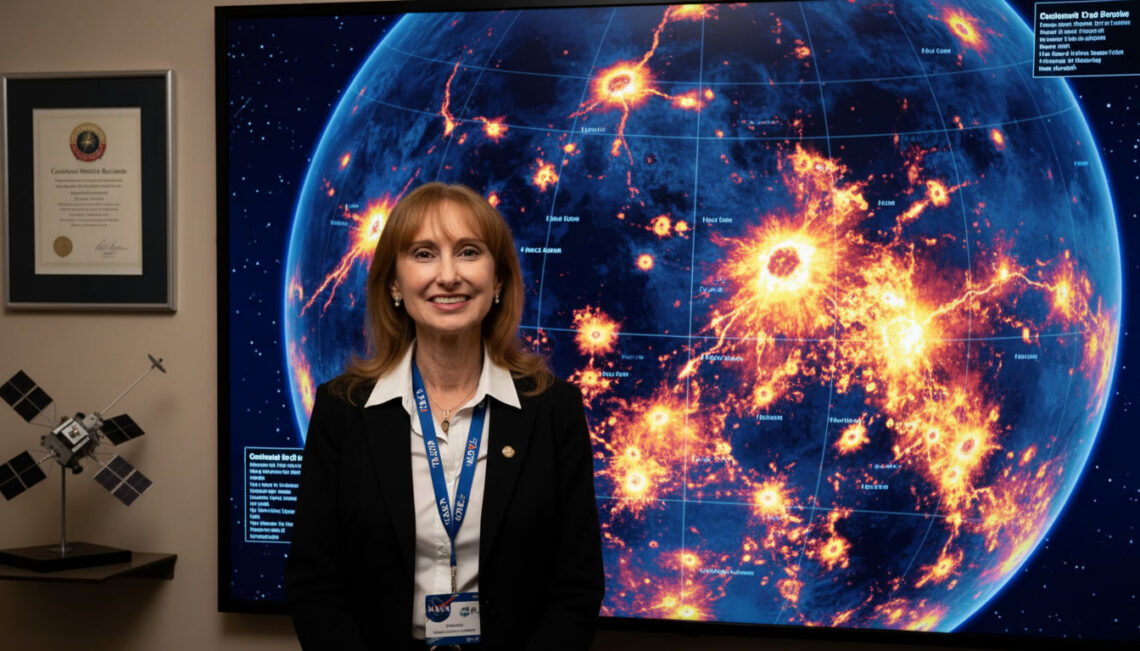
When Galileo reached Jupiter in December 1995, Io proved even more extraordinary than Voyager had shown. Lopes’ NIMS analyses revealed dozens of hotspots (points of intense infrared glow marking active lava lakes, flows, and eruptions) across the moon’s surface, which is painted in sulfurs and their compounds. Some of these volcanoes rivaled or exceeded anything on Earth in energy output.
6.2 A Guinness World Record
Systematically, mission by mission, Lopes identified 71 active volcanoes on Io that no one had seen before. The achievement earned her a place in Guinness World Records for discovering the most active volcanoes anywhere, on Earth or beyond. Her findings, published in leading planetary science journals, reshaped understanding of Io’s interior, its tidal heating, and the behavior of lava in low-gravity environments.
6.3 What Io Teaches Us
Io matters far beyond its own strangeness:
- It is a natural laboratory for volcanism under conditions impossible on Earth
- Its tidal heating (the warming produced by gravity repeatedly flexing a moon’s interior) illuminates the physics that may keep subsurface oceans liquid on Europa and Enceladus, oceans considered prime targets in the search for life
- Its lavas reveal how rocky planets release internal heat, a process that shaped Earth’s own geological history
7. Cassini and the Search for Cryovolcanoes on Titan
Lopes’ second great arena was Titan, Saturn’s giant moon. As a member of the Cassini mission’s radar team, she spent years interpreting radar images of a world whose thick atmosphere hides its surface from ordinary cameras. Her analyses helped identify candidate cryovolcanoes , “ice volcanoes,” structures that erupt water and ammonia slush instead of rocky lava, including the striking combination of Doom Mons and Sotra Patera, a mountain-deep pit pairing considered among the best cryovolcanic candidates anywhere in the solar system.
Cryovolcanism, if confirmed, would show that Titan’s interior exchanges material with its surface and atmosphere, a process with profound implications for the moon’s chemistry and its potential habitability (its capacity to support life). Lopes’ work on Titan connected her two scientific loves: volcanoes and the outer solar system.
8. Leadership and Research at JPL
Across more than three decades at JPL, Lopes combined frontier research with institutional leadership:
- Senior research scientist roles spanning Galileo, Cassini, and subsequent mission planning
- Management of JPL’s planetary science section, guiding one of the largest planetary research groups in the world before returning to full-time research
- Continued contributions to Titan science, including involvement in NASA’s Dragonfly mission, a rotorcraft that will fly across Titan’s surface
- Dozens of field expeditions to terrestrial volcanoes, from Italy to Iceland to Central America, grounding her spacecraft analyses in real eruptions
She has published extensively in scientific literature and authored or edited definitive volumes on Io and planetary volcanism, including the co-edited Io After Galileo (2007) and Alien Volcanoes (2008), which brings extraterrestrial volcanology to general readers.
9. Science Communication: The Carl Sagan Medal and Volcano Adventure
9.1 Bringing Other Worlds to the Public
Lopes holds a distinguished record of public communication in planetary science. She has appeared in numerous science documentaries, given countless public lectures, and written books that transport readers to volcanic worlds. In 2005, the Division for Planetary Sciences of the American Astronomical Society awarded her the Carl Sagan Medal for excellence in public communication in planetary science, one of the field’s highest honors for outreach.
9.2 The Volcano Adventure Guide
Her book The Volcano Adventure Guide (2005) merges science with travel, guiding readers to safely visit and appreciate the world’s great volcanoes. It grew directly from her own fieldwork: Lopes has visited dozens of active volcanoes on Earth, from Mount Etna to Kilauea, insisting that to understand volcanoes on other worlds you must first stand on one.
10. Opening Doors for Latin American Scientists
Lopes has been a tireless advocate for students from Latin America and other regions underrepresented in space science:
- Mentoring Brazilian and international students into planetary science careers
- Supporting programs that connect Latin American universities with space research
- Serving as living proof that a career at NASA can begin in a Rio de Janeiro classroom
- Speaking globally on the importance of international participation in planetary exploration
Her asteroid, 22454 Rosalylopes, named in her honor, traces a path through the solar system she spent her life explaining, a fitting symbol for a career that connected one country’s dreams to the entire solar system.
11. Breaking Barriers as a Woman in Planetary Science
11.1 Persisting in a Male-Dominated Field
Lopes built her career when women were scarce in planetary science and rarer still in mission leadership. She has described the field’s casual assumptions (that women would not want fieldwork, would not lead missions, would not stay). Her response was consistent excellence:
- Producing definitive discoveries that made her indispensable to mission science
- Taking on management roles and returning to research on her own terms
- Combining technical depth with communication skill, multiplying her influence
- Championing other women in NASA and international space science
11.2 Recognition
Her honors include the Carl Sagan Medal (2005), the Guinness World Record for volcano discoveries (2006), the Adler Planetarium’s Women in Space Science Award (2009), and NASA awards for her contributions to planetary missions, alongside an asteroid bearing her name.
12. Legacy and Continuing Influence
Rosaly Lopes redefined what one scientist could discover. Before her, the census of extraterrestrial volcanoes was a handful of plumes seen in flyby images; after her Galileo work, it was a systematically mapped volcanic world. Her Titan analyses extended volcanology to a moon of Saturn and to ices instead of rock, demonstrating that volcanism is a truly solar-system-wide process.
Equally important is who she inspired. A generation of Latin American students saw in Lopes someone who had started exactly where they stood and reached the inner circles of NASA. Her message to them is disarmingly simple: study what fascinates you, work with discipline, and do not let anyone tell you where you are allowed to look.
13. Conclusion
Rosaly Lopes’ career is a testament to the power of combining passion with precision. A girl in Rio de Janeiro who dreamed of volcanoes and space became the scientist who found more volcanoes than anyone in history, on a moon of Jupiter, and then went hunting for ice volcanoes on a moon of Saturn.
Her scientific legacy spans two missions that defined their eras, a transformed understanding of volcanic worlds, and a body of work that connects planetary interiors to the possibility of life beyond Earth. Her human legacy runs through every Latin American student now entering planetary science because she proved the path exists.
As NASA’s Dragonfly mission prepares to fly across the Titan landscapes she mapped, the volcano hunter’s greatest discoveries may still lie ahead.
References:
- Lopes, R. M. C., et al. (2004). “Lava Lakes on Io: Observations of Io’s Volcanic Activity from Galileo NIMS During the 2001 Flybys.” Icarus, 169(1), 140-169.
- Lopes, R. M. C., et al. (2013). “Cryovolcanism on Titan: New Results from Cassini RADAR and VIMS.” Journal of Geophysical Research: Planets, 118(3), 416-435.
- Lopes, R. M. C., & Spencer, J. R. (Eds.). (2007). Io After Galileo: A New View of Jupiter’s Volcanic Moon. Springer-Praxis.
- Lopes, R. M. C. (2005). The Volcano Adventure Guide. Cambridge University Press.
- Lopes, R. M. C., & Carroll, M. (2008). Alien Volcanoes. Johns Hopkins University Press.