Katherine Johnson (1918–2020) established the mathematical foundations for America’s early space achievements through her expertise in celestial mechanics (the mathematics of how objects move through space under gravity), trajectory analysis, and orbital calculations (working out the curved paths a spacecraft follows). Her precise computations enabled historic missions from Alan Shepard‘s first American spaceflight to the Apollo Moon landings, while her insistence on accuracy became legendary among astronauts who trusted only her verification of computer-generated calculations. This article examines Johnson’s technical contributions to space exploration, analyzes the barriers she overcame as an African American woman in institutional science, and evaluates her legacy in expanding opportunities for women and minorities in STEM fields.
1. Introduction
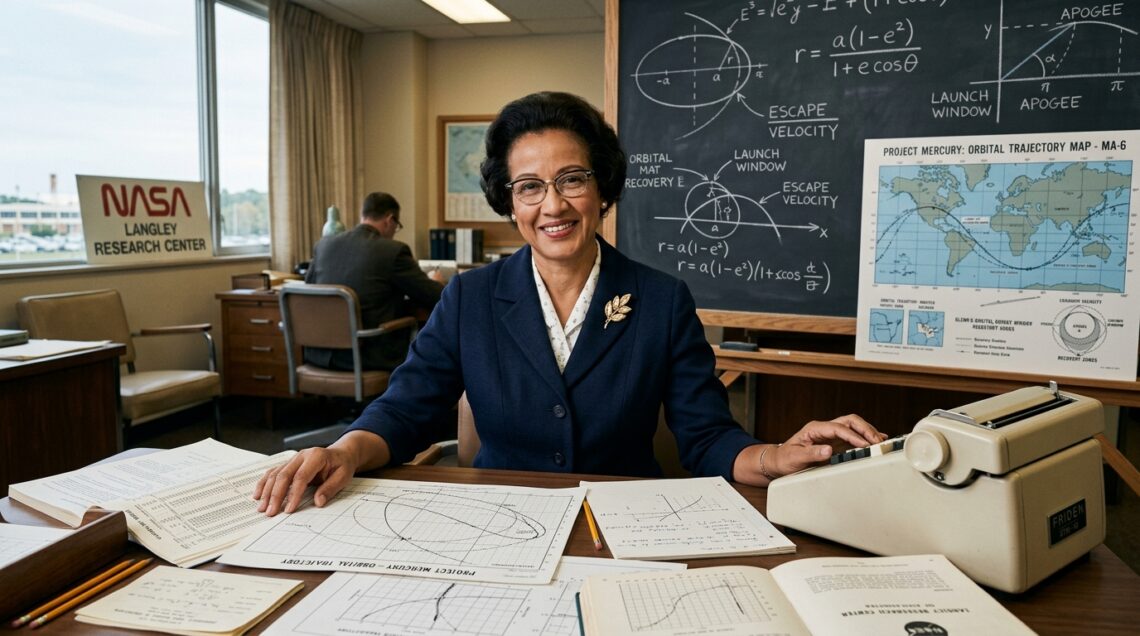
Katherine Johnson’s mathematical calculations determined the difference between success and failure for America’s most critical space missions. As a “human computer”, the job title for people who performed complex calculations by hand, before electronic computers existed, at NASA‘s Langley Research Center, her work enabled historic achievements: the first American in space, the first orbital flight, the Moon landing, and the safe return of Apollo 13 astronauts. When electronic computers were first introduced, astronaut John Glenn famously requested that Johnson personally verify their calculations, demonstrating the trust her precision inspired.
Her career spanned the transition from manual calculations to electronic computing, from suborbital flights to lunar landings, and from segregated facilities to integrated workplaces. Throughout these transformations, Johnson’s mathematical excellence remained constant, proving that ability transcended demographic barriers in technical fields.
- NASA’s official biography: https://www.nasa.gov/centers-and-facilities/langley/katherine-johnson-biography/
2. Scientific and Social Context of the Space Race Era
Johnson’s work emerged during the Cold War competition between the United States and Soviet Union for space supremacy. The Soviet Union’s successful launch of Sputnik in 1957 shocked American leadership and created urgent demand for space capabilities. President Kennedy’s 1961 challenge to land Americans on the Moon before the decade’s end intensified pressure on NASA’s mathematicians and engineers.
Simultaneously, Virginia’s segregation laws created separate facilities for Black and white employees. Johnson worked in the West Area Computing section, a segregated unit of African American women mathematicians, while performing calculations essential to national priorities. This juxtaposition of contributing to historic achievements while facing systematic discrimination characterized the era’s contradictions.
3. Education and Mathematical Foundation
3.1 Early Mathematical Prodigy
Born Katherine Coleman in 1918 in White Sulphur Springs, West Virginia, her mathematical abilities emerged early. She entered high school at age 10 and graduated at 14. At West Virginia State College, she excelled in mathematics under Professor W. W. Schieffelin Claytor, the third African American to earn a PhD in mathematics, who specifically designed courses to prepare her for graduate mathematics work.
3.2 Breaking Educational Barriers
Despite her exceptional abilities, Katherine faced significant obstacles:
- Limited educational opportunities for African Americans in the segregated South
- Few schools offering advanced mathematics to Black students
- Institutional barriers to graduate education at most universities
Nevertheless, she graduated summa cum laude with degrees in mathematics and French, and became one of the first African American women to integrate West Virginia University‘s graduate school in mathematics.
4. NASA Career and Historic Mission Calculations
4.1 Joining NACA and the West Computing Section
In 1953, Katherine joined the National Advisory Committee for Aeronautics (NACA), which would become NASA in 1958. As a “human computer” in the all-Black West Area Computing section, she performed complex mathematical calculations by hand, analyzing flight test data, calculating wind tunnel results (the measurements taken when aircraft models are tested in channels of moving air), and determining aircraft performance characteristics.
4.2 Alan Shepard: First American in Space (1961, Freedom 7)
Katherine calculated the trajectory for Shepard’s historic suborbital flight. Her precise mathematics determined:
- The capsule’s launch parameters for optimal trajectory
- The correct reentry angle for safe atmospheric return
- The precise splashdown point for recovery operations
- Timing for all mission phases to ensure astronaut safety
4.3 John Glenn: First American to Orbit Earth (1962, Friendship 7)
When Glenn became the first American to orbit Earth, he specifically requested that Katherine verify the electronic computer’s calculations. His concern was justified: early computers were prone to errors, and Glenn’s life depended on accurate orbital mechanics. Katherine’s verification confirmed the calculations were correct.
4.4 Apollo 11: Moon Landing (1969)
Katherine’s calculations were crucial for the lunar landing:
- The lunar module’s descent trajectory to the Moon’s surface
- The command module’s successful return trajectory to Earth
- Emergency backup calculations for potential mission problems
- Precise orbital mechanics for the entire mission profile
4.5 Apollo 13: Emergency Return (1970)
When an oxygen tank explosion threatened the Apollo 13 crew, Katherine’s work on backup procedures and navigation charts helped guide the astronauts safely home. Her pre-calculated contingency procedures enabled the remarkable rescue mission.
- NASA’s Apollo 11 mission history: https://www.nasa.gov/mission/apollo-11/
5. Mathematical Innovations and Technical Contributions
5.1 Orbital Mechanics Expertise
Katherine specialized in:
- Calculating launch windows for optimal orbital insertion (the exact moments to launch so a spacecraft settles into its intended path around Earth)
- Determining precise splashdown points for capsule recovery
- Computing trajectories for complex orbital maneuvers (course changes made while circling Earth)
- Developing methods for tracking spacecraft positions relative to Earth
5.2 Navigation Systems Development
Her work contributed to:
- Star pattern recognition methods for spacecraft navigation
- Techniques for determining position without Earth-based tracking
- Backup navigation procedures for emergency situations
- Early approaches to onboard spacecraft computing
6. Breaking Barriers and Institutional Change
6.1 Professional Challenges
Throughout her 33-year career at NASA, Katherine faced:
- Racial segregation in workplace facilities and cafeterias
- Exclusion from professional meetings and briefings initially
- Gender-based assumptions about mathematical ability
- Limited advancement opportunities compared to male colleagues
6.2 Overcoming Through Excellence
Katherine overcame these barriers through:
- Unquestionable mathematical precision in critical calculations
- Consistent reliability in high-stakes mission work
- Persistence in pursuing her right to contribute fully
- Building trust through demonstrated competence
6.3 Integrating NASA Workplaces
Johnson’s presence and excellence contributed to:
- Gradual integration of NASA facilities and offices
- Recognition that talent existed across demographic categories
- Creation of opportunities for other African American women
- Transformation of institutional attitudes toward diversity
7. Legacy and Recognition
7.1 Long-Overdue Recognition
Katherine Johnson’s contributions remained largely unknown until:
- 2015: President Obama awarded her the Presidential Medal of Freedom
- 2016: The book and film “Hidden Figures” brought her story to global attention
- 2019: NASA dedicated the Katherine G. Johnson Computational Research Facility in her honor
- 2021: She was inducted into the National Women’s Hall of Fame
7.2 Changing Perceptions in STEM
Katherine’s visibility has:
- Inspired young women, especially women of color, to pursue mathematics
- Raised awareness about African American women’s contributions to space exploration
- Highlighted the importance of diversity in scientific fields
- Demonstrated that excellence transcends demographic categories
8. The Katherine Johnson Effect
8.1 Educational Inspiration
Young people seeing Katherine’s achievements:
- Understand that mathematics leads to exciting careers
- Recognize that space exploration includes diverse contributors
- See that barriers can be overcome through excellence
- Imagine themselves in STEM fields they might not have considered
8.2 Institutional Legacy
Multiple initiatives honor Katherine’s legacy:
- The Katherine Johnson Scholarship for STEM education
- NASA educational programs highlighting her contributions
- Mathematics competitions named in her honor
- School programs promoting diversity in STEM fields
9. Continuing Impact on Space Exploration
9.1 Mathematical Foundation
The mathematical methods Katherine developed remain fundamental to:
- Orbital mechanics calculations for modern spacecraft
- Space mission planning and trajectory design
- Spacecraft navigation systems
- Emergency procedures for space missions
9.2 Inspiration for Next Generation
Johnson’s story demonstrates:
- Mathematical ability enables historic achievements
- Precision and verification save lives
- Excellence breaks institutional barriers
- Diversity strengthens technical fields
10. Conclusion
Katherine Johnson’s mathematical genius made the difference between success and failure for America’s most critical space missions. Her calculations put the first American in space, enabled the first orbital flight, and made the Moon landing possible. Her insistence on accuracy and her legendary verification skills earned the trust of astronauts who relied on her calculations with their lives.
But her impact extends far beyond those historic achievements. By breaking barriers for women and African Americans in STEM, Katherine demonstrated that scientific excellence knows no demographic boundaries. Her story, brought to light decades after her crucial contributions, continues to inspire new generations of mathematicians, scientists, and engineers, especially women and people of color who see in her career what becomes possible when ability meets opportunity.
The space exploration achievements that define an era relied on Katherine Johnson’s mathematical precision, and her perseverance in the face of discrimination reminds us that scientific progress requires both brilliant minds and the determination to ensure all brilliant minds can contribute. As humanity looks toward Mars and beyond, Johnson’s legacy proves that mathematical excellence remains the foundation upon which space exploration builds.
References:
- Shetterly, M. L. (2016). “Hidden Figures: The American Dream and the Untold Story of the Black Women Mathematicians Who Helped Win the Space Race.” William Morrow.
- NASA. (2017). “Katherine Johnson: A Lifetime of Stardust.” NASA History Division.
- Goble, D. (2020). “Katherine Johnson: The Girl Who Loved to Count.” NASA Educational Materials.
- “Katherine Johnson: Mathematician.” (2020). Biography, National Women’s History Museum.
- Darden, C. (2019). “Katherine Johnson and the Mathematics of Space Flight.” Mathematics Teacher, 112(6), 456-462.