Marie Curie: Origins of Nuclear Science
Marie Curie (1867–1934) established the foundational framework for understanding radioactivity (the spontaneous energy that unstable atoms release as they break down) and revolutionized both physics and chemistry through her systematic investigation of radioactive phenomena. Her discovery and isolation of polonium and radium, her formulation of radioactivity theory, and her development of quantitative methods for measuring radioactive emissions fundamentally altered scientific understanding of atomic structure. This article examines Curie’s technical contributions to nuclear science, analyzes the barriers she overcame as a woman in early 20th-century scientific institutions, and evaluates her dual Nobel Prize, winning research that established radioactivity as a distinct field of study.
1. Introduction
Marie Curie’s name is now inseparable from the concept of radioactivity, though the term itself did not exist before her work. While 19th-century physics had established the existence of X-rays and uranium’s unusual penetrating emissions, Curie’s systematic approach transformed these observations into a unified theoretical framework. Her research demonstrated that radioactivity was an atomic property, a revolutionary insight that prefigured 20th-century nuclear physics and established methodologies still used in radiological research today.
Her contributions spanned both theoretical and experimental domains: she coined the term “radioactivity,” developed techniques for isolating radioactive elements, formulated mathematical descriptions of radioactive decay, and established the first standards for measuring radiation. These achievements earned her two Nobel Prizes in different sciences, a distinction that remains unique in scientific history.
- For the instruments and methods behind her discoveries, see the Musée Curie official website: https://musee.curie.fr/
- Nobel Prize biography and lecture transcripts: https://www.nobelprize.org/prizes/physics/1903/marie-curie/biographical/
2. Scientific and Social Context of Late 19th-Century Physics
Curie’s work emerged during a period of profound transformation in physical science. The discovery of X-rays by Wilhelm Röntgen in 1895 and Henri Becquerel’s 1896 observation of uranium’s penetrating radiation had revealed phenomena that existing physical theory could not explain. The atom was still considered indivisible (the word itself meaning “uncuttable” in Greek) and these emissions suggested a far more complex internal structure.
Simultaneously, institutional science remained overwhelmingly male-dominated across Europe. Women faced systematic exclusion from university positions, research laboratories, and professional scientific societies. In this context, Curie’s achievements represent not only scientific advance but also institutional transformation, as her work compelled recognition of women’s capabilities in the highest tiers of research.
3. The Underground Education and Formation of a Research Scientist
3.1 The Flying University
Born Maria Skłodowska in Warsaw in 1867, Curie developed her scientific foundation under conditions of institutional exclusion. Russian-controlled Poland had prohibited women from universities, prompting the formation of clandestine “Flying University” (Uniwersytet Latający)—educational networks that operated in private homes to avoid detection. These institutions provided both scientific instruction and political education, fostering a generation of Polish intellectuals despite systematic repression.
3.2 The Sorbonne and École Normale Supérieure
Curie’s migration to Paris in 1891 granted access to formal education at the Sorbonne, where she pursued degrees in physics and mathematics while supporting herself through tutoring and laboratory work. Her encounter with Pierre Curie, a physicist specializing in crystallography (the study of how atoms are arranged inside solids) and magnetism, initiated a collaboration that would transform both their careers. Their marriage in 1895 created a scientific partnership built on shared experimental interests and complementary expertise. Pierre’s instrumental skills complemented Marie’s systematic approach to chemical analysis.
4. The 1903 Nobel Prize in Physics: Discovery of Radioactivity
4.1 Research on Uranium Rays
Curie’s doctoral research, begun in 1897, focused on systematic investigation of uranium rays discovered by Henri Becquerel. Using instruments developed by Pierre (including an electrometer capable of measuring extremely small electrical currents) she conducted quantitative studies of radiation’s ionizing properties (its ability to knock charged particles loose from atoms, producing currents her instruments could measure). Her crucial insight was to compare emissions from pure uranium compounds with those from uranium-bearing minerals, revealing that many minerals emitted more radiation than could be explained by their uranium content alone.
4.2 The Hypothesis of Unknown Elements
This discrepancy led Curie to formulate a revolutionary hypothesis: the excess radiation originated from previously unknown elements present in trace quantities. Her systematic approach involved chemically separating mineral components and testing each fraction for radioactivity. This method would transform the study of radiation from qualitative observation to quantitative analysis, establishing experimental protocols still used in radiochemical research.
4.3 Discovery of Polonium and Radium
In 1898, working with pitchblende ore from the Austrian mines at Joachimsthal, the Curies announced the discovery of two new elements:
- Polonium (July 1898): Named in honor of Marie’s native Poland, then struggling for independence from partitioning powers. The element demonstrated intense radioactivity, approximately 400 times greater than uranium.
- Radium (December 1898): Isolated through more complex chemical processes, radium exhibited radioactivity over two million times more intense than uranium. Its spectral lines confirmed it as a distinct element with different chemical properties.
These discoveries fundamentally altered understanding of atomic structure and established that radioactivity was a property of specific elements rather than a general characteristic of matter.
4.4 The Nobel Prize Recognition
The 1903 Nobel Prize in Physics was awarded jointly to Marie Curie, Pierre Curie, and Henri Becquerel “in recognition of the extraordinary services they have rendered by their joint researches on the radiation phenomena discovered by Professor Henri Becquerel.” The citation specifically acknowledged the Curies’ “researches on the radiation phenomena discovered by Professor Henri Becquerel” and their discovery of radium.
Initially, the Nobel Committee intended to exclude Marie from the prize, awarding it only to Pierre and Becquerel. Pierre Curie protested this omission, refusing to accept the prize unless Marie’s essential contributions were recognized. This intervention established Marie Curie’s legitimate standing in the scientific community and marked the first time a woman would receive the Nobel Prize in Physics.
5. The 1911 Nobel Prize in Chemistry: Isolation and Characterization of Radium
5.1 From Discovery to Quantitative Isolation
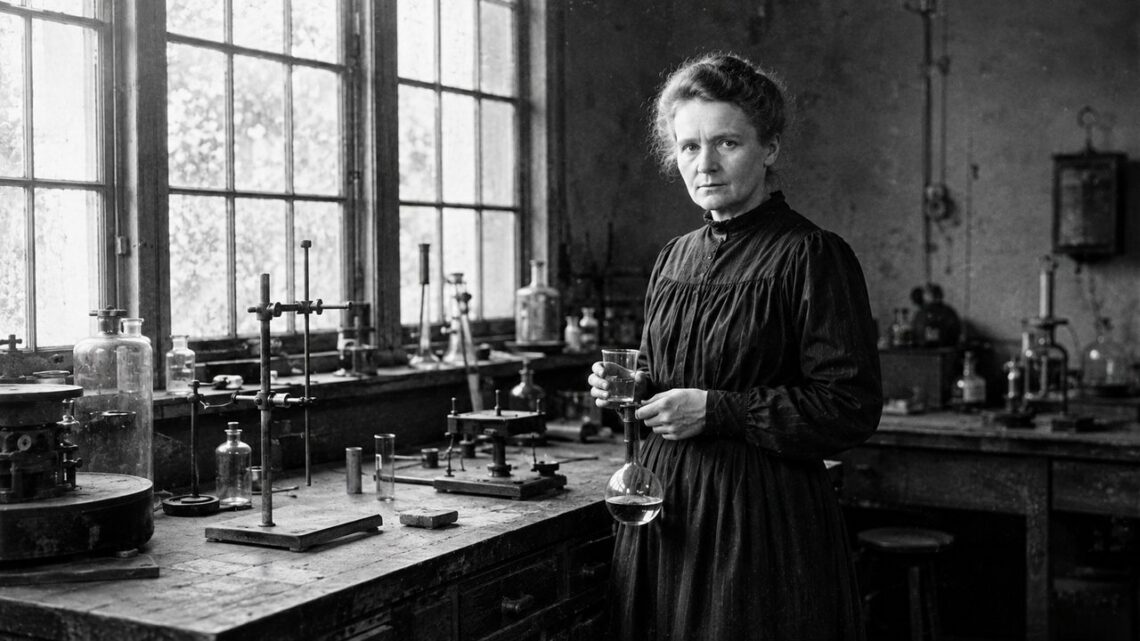
Following the 1898 announcements, Curie undertook the arduous process of isolating radium in pure metallic form. This required processing tons of pitchblende ore (a dense rock rich in uranium) to extract gram quantities of radium salts. Working in a converted dissection shed with poor ventilation and inadequate protection from radiation, Curie manually processed ore through multiple chemical separations, crystallizations, and purifications that continued for nearly a decade.
5.2 Determination of Atomic Weight and Chemical Properties
By 1907, Curie had isolated sufficient radium chloride to determine the element’s atomic weight with precision. Her value—226 atomic mass units—remained the accepted standard for decades. She also systematically characterized radium’s chemical properties, demonstrating that despite its intense radioactivity, radium behaved as a true alkaline earth metal (the chemical family that includes calcium and barium), analogous to barium in its compounds.
5.3 Establishment of Radioactivity Standards
Curie’s work with radium established the first international standards for measuring radiation. The “Curie,” defined as the quantity of radioactive material emitting 3.7×10¹⁰ disintegrations per second, became the standard unit of radioactivity and remains in use today. This achievement transformed radioactivity from a laboratory curiosity into a quantifiable physical property that could be standardized and compared across laboratories.
5.4 The Nobel Prize Citation
The 1911 Nobel Prize in Chemistry was awarded to Marie Curie alone, in recognition of her discovery of radium and polonium and her isolation of radium in pure metallic form. The full citation honored her “services to the advancement of chemistry by the discovery of the elements radium and polonium, by the isolation of radium and the study of the nature and compounds of this remarkable element.”
This second Nobel Prize, awarded independently eight years after Pierre’s death in 1906, established Curie’s scientific standing on entirely her own merits. She remains the only person to have received Nobel Prizes in two different scientific fields.
6. Medical Applications and Humanitarian Service
6.1 Radiological Mobilization During World War I
During World War I, Curie recognized that radiology could transform battlefield medicine. She developed mobile X-ray units (“Petites Curies“) that could be deployed to front-line surgical stations. These units, powered by portable generators and equipped with X-ray tubes of her design, enabled surgeons to locate bullets, shrapnel, and bone fractures before operating, dramatically improving survival rates and reducing amputations.
Curie personally trained operators, organized radiological services, and drove vehicles to the front lines, often under artillery fire. By war’s end, her efforts had established over 200 permanent and mobile radiological posts, examining over one million wounded soldiers.
6.2 Foundations of Nuclear Medicine
Curie’s research established the therapeutic potential of radiation. Radium’s gamma rays (a deeply penetrating form of radiation) could destroy cancerous cells more selectively than surgery, launching the field of radiation oncology. The Curie Institutes she founded in Paris (1920) and Warsaw (1932) became leading centers for cancer treatment and radiological research, establishing protocols that would influence medical practice worldwide.
7. Institutional Legacy and Impact on Women in Science
7.1 The Curie Institutes
The Institut du Radium in Paris and the Institut Radium in Warsaw embodied Curie’s vision of institutions combining fundamental research with medical applications. Both centers provided opportunities for female researchers when few European universities hired women in scientific positions. The Paris institute would host four additional female Nobel laureates, Irène Joliot-Curie, her daughter, among them.
7.2 Breaking Institutional Barriers
Curie’s achievements forced institutional change. Her 1906 appointment as Professor of Physics at the Sorbonne made her the first woman to hold a chair at a French university. Her 1911 election to the French Academy of Medicine, though she would be denied membership in the Academy of Sciences, demonstrated both progress and persistent barriers. Her presence in laboratories, lecture halls, and professional societies gradually normalized women’s participation in institutional science.
8. Conclusion
Marie Curie’s work established radioactivity as a distinct field of scientific inquiry with theoretical foundations, quantitative methods, and practical applications. Her two Nobel Prizes recognized distinct achievements: the 1903 prize for discovery of radioactivity and new radioactive elements, the 1911 prize for isolation and characterization of radium. These contributions transformed both physics (by establishing that atoms contained sources of radiation) and chemistry (by adding two new elements and creating methods for their isolation).
Beyond scientific advance, Curie’s career demonstrated that institutional barriers could be overcome through persistent excellence. Her life established models for women in STEM fields that remain relevant: the importance of mentors and collaborative partnerships, the necessity of institutional support for combining research with family responsibilities, and the value of applying fundamental discoveries to human needs.
Her legacy persists in the continuing research of the Curie Institutes, in the standard units of radioactivity that bear her name, in the therapeutic applications of radiation that emerged from her discoveries, and in generations of women scientists who followed paths she made possible.
References:
- Curie, M. (1904). “Rayons émis par les composés de l’uranium et du thorium.” Comptes Rendus de l’Académie des Sciences, 138, 177-181.
- Curie, M. (1911). “Radium and Radioactivity.” Nature, 86(2185), 317-319.
- “The Nobel Prize in Physics 1903: Marie Curie.” Nobel Foundation, Nobel Lecture.
- “The Nobel Prize in Chemistry 1911: Marie Curie.” Nobel Foundation, Nobel Lecture.
- Curie, È. (1937). Madame Curie: A Biography. Doubleday.